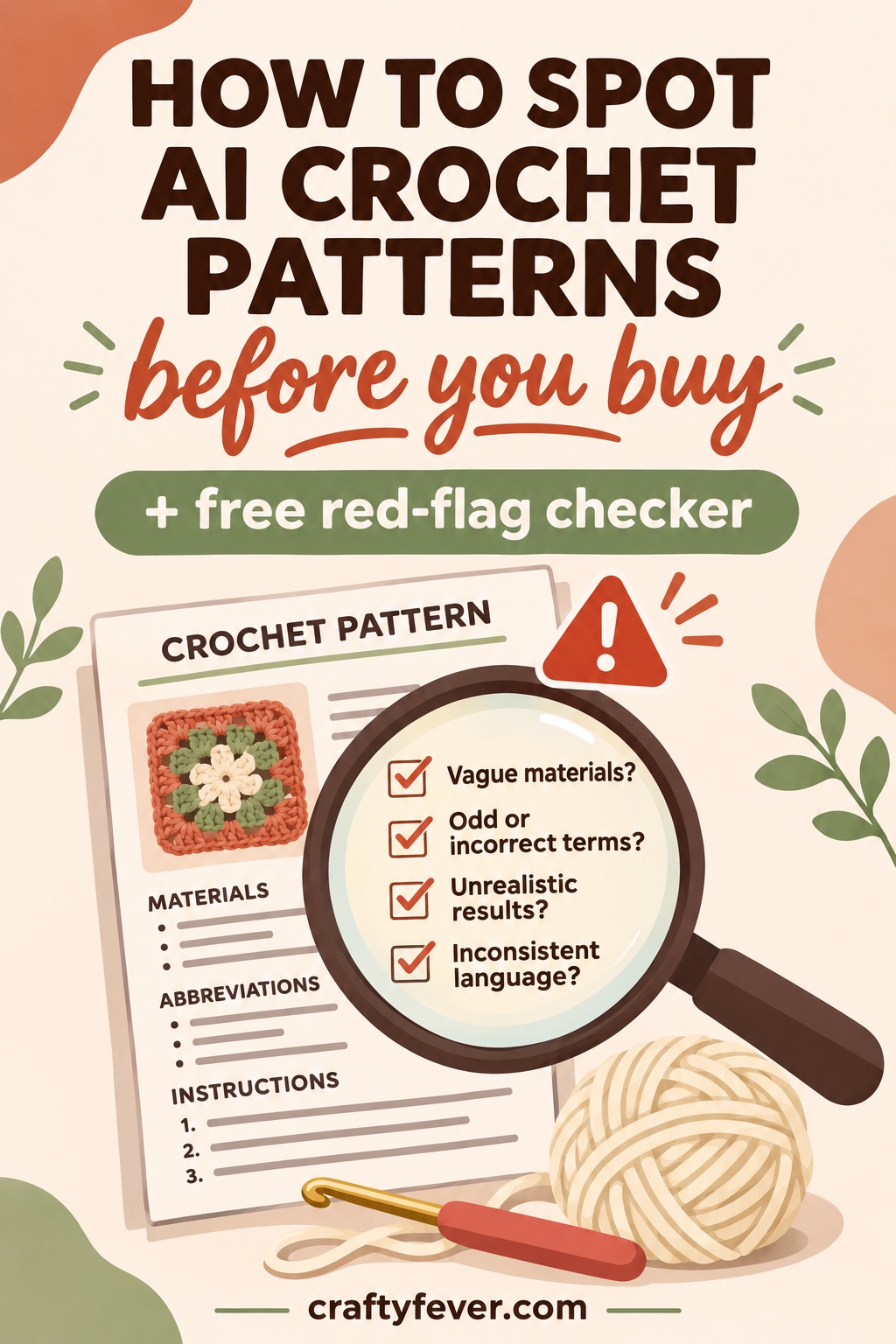
You find the cutest amigurumi dragon on Etsy or Pinterest, pay for the PDF pattern, spend a whole weekend crocheting… and end up with a lumpy blob that looks nothing like the photo. If that has happened to you, you’re not alone. Crocheters have been reporting patterns sold with AI-generated images for years, and many of those patterns were never tested by a real person (or were generated too).
The good news: on October 22, 2026, Etsy banned AI-generated patterns, and sellers now have to show a real item made with their instructions. The bad news: plenty of these listings are still out there, on Etsy and everywhere else. Here’s how to spot an AI crochet pattern before you buy, plus a free checker that does the math for you.
Quick Answer: 7 Red Flags of an AI Crochet Pattern
- Only one “perfect” photo, with no back, side or close-up views.
- Stitches you can’t count, or stitches that melt together and change size.
- Details yarn can’t make: glossy surfaces, tiny realistic claws, fur, perfect gradients.
- No reviews with buyer photos of the finished item.
- A brand-new shop with hundreds of patterns.
- No yarn weight, hook size, gauge or finished size in the listing.
- Phrases like “image for illustration only” or “results may vary” in the description.
Not sure about a specific listing? Answer the questions in the checker below.
Free AI Crochet Pattern Red-Flag Checker
Open the listing you’re unsure about and answer the questions below. The checker adds up the warning signs and tells you how risky the purchase looks. Nothing is sent anywhere: everything runs in your browser.
Look closer at the listing photo
Save the main listing photo to your device and open it here, then move your mouse (or finger) over it to zoom in on the stitches. The image stays on your device: it is never uploaded.
What an AI “Crochet” Image Looks Like

This image was generated with AI for this article, to show the typical signs. It is not a real crocheted toy and there is no pattern for it.
At first glance it looks adorable. Look closer and the problems pile up:
- The “stitches” are beads, not loops. They change size randomly and don’t form rows or rounds.
- The eyes are glassy and sparkling, far beyond what safety eyes look like.
- The claws are glossy and pointed, more like resin than yarn.
- The spikes look like real fur. Brushed yarn can be fluffy, but not like this.
- The colors fade smoothly from teal to purple with no color-change lines anywhere.
- There are no seams where the wings, horns or legs would be sewn on.
10 Ways to Spot a Fake Crochet Pattern (In Detail)
1. Check how many photos there are
Real designers photograph their sample from every angle, because buyers ask. If a listing has one dreamy hero image and nothing else, be careful. Bonus points for photos of the item being held, in progress, or next to a ruler.
2. Zoom in on the stitches
Single crochet looks like little V’s or X’s that follow the shape in neat rows or rounds. AI images usually show texture that looks knitted or crocheted from far away but turns into blobs, beads or random squiggles up close. If you can’t count stitches, nobody could have written a pattern from it.
3. Ask: could yarn really do this?
Yarn has thickness. A palm-sized toy can’t have realistic fingers, eyelashes, translucent wings or shiny surfaces. Flowing gradients across the whole piece, perfect circles and paper-thin edges are also signs the image wasn’t made with a hook.
4. Look for normal handmade imperfections
Seams where parts are joined, a visible color change “jog”, slightly uneven ears, a bit of fuzz: these are good signs. A handmade item that is perfectly symmetrical from every angle is suspicious.
5. Read the reviews and look at buyer photos
Reviews with photos of finished items are the best proof that a pattern works. On Etsy, check reviews for the listing and the whole shop. Lots of 1-star reviews saying “doesn’t look like the picture” is a clear answer.
6. Check the shop’s age and output
Designing and testing a pattern takes days or weeks. A shop that opened a few months ago and already has hundreds of patterns in the same glossy style is almost certainly not designing them by hand.
7. Look for real pattern details
A real listing tells you the yarn weight, hook size, gauge (or at least finished size), skill level, the stitches used and how many pages the PDF has. Vague descriptions like “easy pattern, all you need is yarn” are a red flag.
8. Search for the designer elsewhere
Most real designers have a Ravelry page, an Instagram account, a YouTube channel or a blog with work-in-progress photos. If the shop name exists nowhere else on the internet, that’s worth noticing.
9. Be careful with huge cheap bundles
“200 amigurumi patterns for $4” is rarely a good deal. These bundles are often generated or copied from other designers.
10. Read the small print
Phrases like “image for illustration purposes”, “AI-assisted design” or “your result may look different” are the seller admitting the photo isn’t the real result. Under Etsy’s new rules, that’s not allowed for patterns anymore.
Etsy’s New Rules on AI Patterns (October 2026)
According to CNBC’s report on Etsy’s announcement:
- Etsy no longer allows AI-generated “functional guides”, which includes patterns, recipes and instructions.
- Sellers must show an actual item made using their instructions, not an AI-generated or simulated result.
- Listings need at least one unedited photo of the actual item, and bot-generated listings with no human involvement are banned.
- AI-generated art is still allowed if sellers disclose it and play a clear role in creating it.
That gives buyers something concrete to point to: if a pattern listing only shows an AI image, it breaks Etsy’s rules.
Already Bought an AI Pattern? Here’s What to Do
- Message the seller and ask for a photo of their own sample made from the pattern. Real designers can usually send one right away.
- Ask for a refund. If the seller doesn’t help, go to your Etsy purchases and use the option to get help with the order.
- Report the listing using the report link on the listing page, so it can be reviewed under the new AI rules.
- Leave an honest review, ideally with a photo of what the pattern actually produced. It protects the next buyer.
- On Pinterest, report pins that lead to fake patterns so they’re shown to fewer people.
Where to Find Real, Tested Patterns
- Designers who show their process: work-in-progress photos, video tutorials and tester photos are the best sign of a real pattern.
- Patterns with project galleries, where other crocheters share what they made from the same pattern.
- Free patterns from established crochet blogs where you can see the designer’s other work. Try our cute bunny free crochet PDF pattern.
For Pattern Designers: How to Prove Your Pattern Is Real
Honest designers are hurt by AI listings too. Make it easy for buyers to trust you: show several real photos of your sample from different angles, add a progress photo or a short video, share tester photos with permission, and list all materials and measurements. Our guide on how to photograph products for Etsy has easy tips (and a free photo shot list).
FAQ
Can an AI detector tell if a crochet pattern photo is fake?
Not reliably. AI image detectors often get it wrong in both directions, so don’t trust a single “AI or not” score. Checking the listing for red flags, like our checker does, is much more dependable.
Are AI crochet patterns banned on Etsy?
Yes. Since Etsy’s policy update announced on October 22, 2026, AI-generated patterns, recipes and instructions are not allowed, and sellers must show a real item made with their pattern.
Does a very professional photo mean the pattern is fake?
No. Many designers take beautiful photos. The difference is that real photos still show real stitches, seams and small imperfections, and there are usually several angles. Look at the details, not just the overall polish.
Final Thoughts
A crochet pattern is a promise: follow these steps and you’ll get this result. Before you buy, take one minute to zoom in, check the reviews and look for real photos. If a listing fails the red-flag checker, skip it and support a real designer instead. Save this guide to Pinterest and share it with your crochet friends: the more buyers know these signs, the harder it gets for fake patterns to sell. 🧶